Area: 11.043 km ²
Population: 1,603,137 (1990)
Traffic Code: 16
Bursa is located in the northwest of the Anatolian peninsula and southeast of the Marmara Sea. On the east coast of the Marmara Sea are 135 km. The main peak in the province of the Uludag, which is the ski resort and national park. The largest lakes are Lake and Lake Uluabat emerged.
Districts: Nilüfer, Yildirim Osman Gazi, Büyük Orhan, Gemlik, Gürsu, Harmancık, İnegöl, emerged, Karacabey, kale, Kestel, Mudanya, Mustafa Kemal pasha, Orhaneli, Orhangazi and Yenisehir district Bursa province.
Arising Emerged, with its thousand years of cultural heritage, occupied an important place in history. After the four main Empire, is one of the notable places of settlement.
History There are traces of civilization dating back to the 2500th years before Christ in Karadin, Çiçekli, Yüğücek and Çakırca Mounds near emerged. Solution before imigracijskih Trak Tribes in the 7th century BC, took the name Helikare. The word "Khryseapolis" (Golden City) is otisnut of the coins are minted in the city.
After renewed by Antigone, General Macedonian emperor Alexander the Great in 316 BC, the city is renamed Antigoneia. After the death of Alexander the Great, the city is the general Lysimakhos victory in the fight against Antigonos name and the city of Nicaea, which is also the name of his wife. In 293 BC, has become a part of Bithynia Kingdom. The city is decorated with important architectural structures. Nicaea, after which was the capital of the Kingdom of Bithynia for later in the continuation of its presence as an important settlement area of the Romans.
Nice met Christianity by efforts Petrus, one of the students of Bithynia. During the rule of Emperor Constantine I, on the prohibition of Christianity deleted. In the early summer of 325 AD, Nicaea was an important meeting place 1st Consul in Senatus palate. The text consists of 20 members, known as the laws nice, Christianity and ljetovanje were adopted after these consultations.
In 787 AD, 7 Consul gathered in the church of St. Sophia emerged. The ban on images and sculptures deleted under the leadership of Empress Irene.
Emerged was also the capital of Byzantium Seljuks and through history.
After it is captured by the Turkish army in 1331, emerged a more active city center of art, culture and trade. Many famous people conference Orhan Ghazi Muslim secondary school in that period. The first mosque, Madras and İmaret (dining) from the Ottoman period, built in emerged.
Emerged is a center of art in the age of 14 and 15, and the world famous tiles and ceramics were produced here. Texture of the city, with its network of settlements planned city Hellenistic Age and monumental buildings of the Romans, Bizantinaca and the Turks, was the preservation emerged.
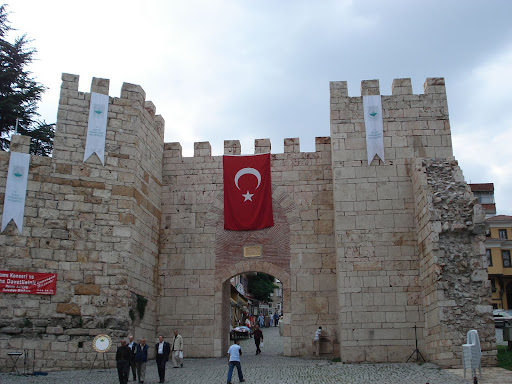
CASTILLOS Bursa Castle: Bursa Castle was in existence and in the 1st century BC. Today, the wall about 2 km long. There are two towers between Çakırhamam and Tophane, one to another around the square. On the road that leads to the Tophane Castle Gate. There is a natural wall at the site Topan, Tumen 'and Art Institute to Yıldız Kahve, in front of the Thermal Gate (Kaplice). Wall still here at the Dungeon Gate (Zinda). There are remains of a prison here on both sides of the wall. The best preserved in the wall of the gate Üftade. In plain Pınarbaşı to Cilimboz course, there is a double wall. Pınarbaşı the fourth city gate Spring Gate (Pınarbaşı). The fifth gate, Yer door is Üftade. The cave is on the wall is 79 meters long and 5 m wide and 4 meters high.
Yer drops: This is one of the doors to the gate of the city of Bursa and is located close to the mosque Üftade.
Arising Castle: The castle dates back to 258 g. before Christ. There are 4 doors castle Istanbul, Yenisehir, Lefka and goal, respectively. Besides these, there are 12 secondary entrances. Strengthen the 4970 m long and 10-13 m high walls, 114 towers were built with them. Old round tower, and the latest square. In addition, there are other towers along the 131 line of defense against the walls of the castle. Emerged walls are repaired with the majority of the rubble of the old town which is used for this task. In bizantskom period, strengthen the walls against the Arab Invaders different materials used. In Istanbul, relief and Lefka Gates presented the battle from the 3rd century before Christ.
Lefka Gate: emerged door that was built for Hadrian in the 2nd century The door is actually composed of 3 doors, within one second.
Doors Istanbul: Built during the rule of the Roman emperor Vespasianus in 3rd century, has 3 doors on the side of the page.
Yenisehir Gate: This is the southern gateway to the city. Was built between 270-288 AD during the rule of Claudia. Today, much is in ruins.
UATERFALLS Saitabat Waterfall: This waterfall, 3 km from the village falls Derekızık barrel. This place of recreation with its restaurants that offer food to the grilling of all kinds is frekuented by the inhabitants of Bursa.
Suuçtu Waterfall: Located 18 km Mustafakemalpaşa, Suuçtu waterfall is in the middle is a natural paradise and HUKA water falling 38 meters is very pleasant. Karadere streams and start Kavaklıyayla the top of the hill Çataldağ. and then come here to make up the waterfall. This is also the source of water for the city of Mustafakemalpaşa and 15 surrounding villages.
Aras Waterfall: If you put Bursa Uludag asfaltirano and turn on the road that leads through the forest, when it comes to the door of the National Park, one arrives at the village Soğukpınar at the altitude of 1,000 m. 30 km to Bursa Soğukpınar, but asphalt is 5 km to the hilly Ketenlik are gravel.
Because people have to have high Ketenlik marked hiking trails and is located north of the Aras and pile in the stream rocky area full of water from melting snow Uludag and falls from heights of 15 meters. Altitude of 1700 meters.
Religious monuments and tombs
Yesil Moskue (Bursa) Yesil (Çelebi Sultan Mehmet) Tomb, Ulu Mosque (Cami Kebir), Muradiye (Murat II) and the Muradiye Medresesi mosque, the Emir Sultan Mosque and Tomb, Yildirim Mosque, Tomb Yildirim, Yildirim Compleks, Yesil Compleks, the tomb of Osman Gaza, the tomb of Orhan Gazi, Muradiye (Murat II) mosque, the tomb Hatuniye, Şehzade Mahmut's Tomb, the tomb of Mustafa Şehzade (Cedid Mustafa), the tomb of Mustafa Şehzade (Ahmet) (Cem Sultan), Mükrime Hatun's Tomb, the tomb of Mustafa fire dogs, grave Hamzabey and Orhan Bey Mosque.
Bursa mosques and tombs Churches and synagogues
Bursa is one of the province, which is the cradle of civilization and a series of pre-Christian religious times to today. There are many Christian, Jewish and Muslim structures still standing and now under the protection of the government. 17 Council of the church so important to the Christian faith calls between 324 and 1563, eight of them occurred in Turkey and 1 and 7 held in emerged. Emerged is a pilgrimage of 8 points in Turkey and the most important.
Gerus synagogue: Selim II synagogue built in the early 16th century. It lies in the street Arap Sucre. Jews expelled from Spain in the late 14th century, and were put on galleons sent by osmanskog Empire and the refuge. The first group is in Bursa and the synagogue was built for them. The fact that the synagogue called Gerush, which means "istjerani" in Hebrew, it is very symbolic of their suffering.
Gerus synagogue is still in excellent character. It is well maintained and open to believers. The medallion on both sides of the office Ehal Akodesh, when the Torah is stored have hebrew inscriptions recording the construction date and the name of the master builders. No other record that lists all the details of construction.
ETS Ahayim synagogue (a tree of life) is important in the sense that the synagogue was first built during the Turkish period. An imperial edict made during the rule of Orhan Bey is a conqueror of Bursa, gave permission for the establishment of this synagogue.
Synagogue: Group Jews from the Spanish island of Mallorca, who are offered refuge in osmanskog Empire were settled in Bursa and built this synagogue. The name is derived from the names of islands of which they arrived. Synagogue is open for events and a section reserved for the washing of the dead are still used.
French church, made of stone, the pulpit and mihrab in separate small rooms. The church is covered with roof made of wood and clay tiles. There was a recovery room for patients here. It is believed that it was built in the 19th century.
H. Georgios Church (Gölyazı) built in the second half of the 19th century, the church is a rectangle, whose walls are built of alternating layers of brick and gravel. Part of the original wooden structure remains.
Church People Harman: (Karacabey) launched in 1833, the building was not completed until 1903. Today the roof of the church is gone, and many of the walls are falling.
Church emerged (emerged) A rectangular church was built in the 7th century. There are 9 different sections church. The walls are of brick and stone vaults in the ceiling of the brick.
Koımesıs Tes Theotokos: (emerged) Koimesis means the death of Mary. "The church is believed to have been built in the 8th century, and his name gets the frescoes depicting the death of Mary. The church is completely destroyed in 1922. Only the foundations remain marble.
Church of St. Tryphonos: (emerged) built by the emperor's Edict T. Laskaris in the 8th st, a rectangle design, with four brackets in the form of the Greek Cross. The walls are built using a technique in which the alternating layers of rubble covered with two to four layers of brick. Column and the title of the marble columns.
Karakocan People's Church (Karacabey) The church was built in 1847 in honor of Zoodochos pege. Today, more than a ruin, the highest level is completely fell in.
Koımesıs Tes Theotokos: (Demirtaş) Built in 1834 and turned into a mosque in 1924, the church is basilica. The walls are made of brick and gravel.
Church Konstantinos H.: (Elena) (Gölyazı) found on the island in the lake Uluabat monastery, the church was built in the 4th and 5 century. On the walls of the Greek - the kind of cross church 5 level brick naizmjenice with the level of rough stone.
Church Kumyaka: (Mudanya) built between 780-797 AD during the rule of Byzantine Emperor Konstantinos Porphyrogenetos IV, was the square with a large dome in the middle and 4 sides are arch form Cross. The walls are made of brick and stone and tile roof.
Michael Church Taksiarches: (Demirtaş) Church was built in the 19th century, and became a mosque in 1948. It is a rectangular structure with a wooden ceiling. Internal walls debris were carried out.
Church Mudanya (Mudanya) Built in 1834, the church is rectangular in shape. On the eastern side of the church is a half circle apse. Walls of stone carved Partial covered the marble.
Church Theodoros (Kali) two parts of this Byzantine structure remain here. One of them is the remains of the ancient city wall in the place which was later built. The second is the church of San Theodoros. Little is known about this church.
Yildirim Medresesi (religious school) in the northwestern Yildirim Mosque, was built in 1399 by Bayezit. Entering the door, the dome porch with 3 sides. 8 rooms has vaulted to the arcade in right and left. There are rooms for teachers (Hoca) on both sides of entries. Side porches are connected orbed in the classroom. After you returned to school was used as a clinic.
NE ostaviti bez
- Display Cumalıkısık
- Skiing in grmu. Uludag
- The visit mosque complex
- Leave one of the hot springs
- Try some of the delicious Iskender kebabı, Kemalpasa sweet dessert and chestnut
- Purchase of Bursa silk
 Location: Ontario’s 36 km. Uludag is amid in the south of the country’s a lot of accepted winter sports center. With the affluence of flora and fauna in 1961 was declared National Park.